

Your Wish is My Command
A Soldier Speaks Profound Truth

What’s your first thought about the word “Command?”
In the Gospel reading last Saturday (June 27), a Roman commander got me re-thinking:
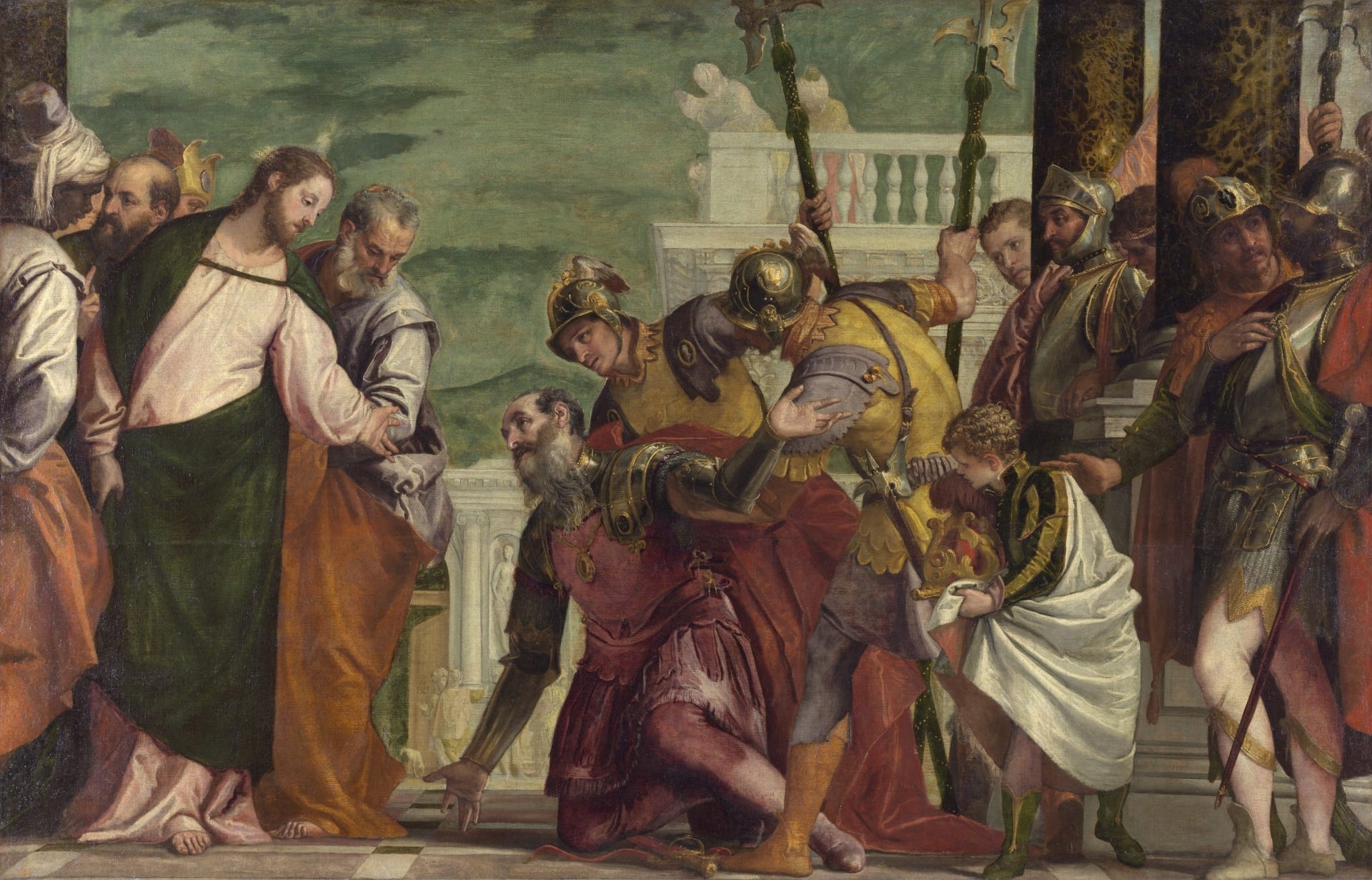
The Gospel Story.
“When Jesus entered Capernaum,
a centurion approached him and appealed to him, saying,
‘Lord, my servant is lying at home paralyzed, suffering dreadfully.’
He said to him, ‘I will come and cure him.’
The centurion replied, ‘Lord, I am not worthy that you should enter under my roof.
Only say the word and my servant will be healed.
For I too am a man subject to authority,
with soldiers subject to me.
And I say to one, “Go,” and he goes;
and to another, “Come,” and he comes;
and to my slave, “Do this,” and he does it.’
When Jesus heard this, he was amazed and said to those following him,
‘Amen, I say to you, in no one in Israel have I found such faith …
And to the centurion Jesus said,
‘You may go; as you have believed, let it be done for you.’(Matthew 8:5-17)
The Roman centurion was a commander, in the chain of command, subject to authority above him, issuing commands to those under him.
He perceived that Jesus was also a commander, The Commander of all.
Rethinking the Word Command.
We modern folk tend to think of the word command as a matter of force, powered by fear. We’ve been taught to “request,” or “negotiate,” but never to command.
Command, we’ve been taught, is arrogant, bossy, and disrespectful. At a minimum, it’s bad manners. Right?
I’m not so sure—
I’m thinking now of the beautiful action of horse and rider in the equestrian events. They jump as one. In action, they are one.

Horse trusts rider, rider trusts horse, in a competition where a split-second’s hesitation means defeat. Command may mean no more than a gentle whisper, or a nudge, and action occurs instantly.
“Only say the word … ”
I’m also thinking a of what happens when we flip a light switch on a wall. Electricity flows. A lamp on the other side of the room comes on, instantly. For all intents and purposes, the switch and the light bulb are one.
“Let it be done … ”
Command, generically speaking, is will, instantly and automatically carried out in action by another.
For that to happen, both commander and commanded must be in complete communion, like one’s brain and a hand.
When my hand receives a signal from my brain (“scratch that itch on our cheek”), there’s no hesitation, no question whether to obey, no thought of disobeying, or obeying only because it might be punished. Those are not factors at all.
Like the switch and light bulb, the will, the command, and the action are instantaneous.
Why?
In our 21st-century woke mindsets, we might analogize the hand to a “slave,” unjustly subject to a “slavedriver” of the mind, something “evil.”
But the centurion prompts me to think that the essence of true command is not a matter of “slavery” or “evil.” It’s not even a matter of issuing “orders.”
The hand and the mind are literally ONE, in the same body.
The mind commands, the hand receives it and acts, but it’s all one thing:
The person acts.
Saint Paul’s brilliant concept (see 1 Corinthians 12:12-27) portrays the hand as a member of the one body whose head is the brain. The hand never regards itself as independent; nor regards itself as a slave who ought to be independent.
Command, then, is a matter of complete and utter communion.
(To the contrary, a barked order, enforced by a whip, can’t truly be called command, because the barker regards the other person as separate and unwilling. They are not one.)
In the equestrian event, both horse and rider know they are in it together. Each trusts the other. That’s what I think the centurion meant by command.
He was intuitively certain that his servant would be healed simply by Jesus saying so, i.e. commanding it.
The Centurion’s Insight.
Yes, it’s true that the centurion understood things in a soldier’s context, where fear and punishment were factors, but he also knew that a good soldier obeys without them, while a good leader commands with total confidence in the soldier.
The centurion stated something universal.
The significance of his understanding is that a command flows, like the electricity between switch and bulb, unlike a request, or a petition, or a plea.
A request requires consideration, evaluation, and decision. These take time.
But true command requires only a willing recipient in a relationship of total trust.
The centurion instinctively understood that Jesus had authority and command over everything, and that his commands operated instantly over time and distance.
Because the centurion trusted his own commands to be carried out, he reasoned why wouldn’t Jesus’?
A Command Is Something Special.
So, unlike other forms of instruction, direction, or coaching, a command is the function of a deep and abiding relationship—rider and horse, centurion and soldier, brain and hand, wall switch and electric light bulb—where there’s no doubt, no hesitation, no question about what will occur.
Anything else is just hot air, bluster, noise without result.
Command and Faith go hand-in-hand.
God’s commands, like the others, flow, not because he’s God, but because that’s the nature of command.
More important, God’s commands are Holy. Like the horse and rider, we can trust them, and God can trust us.
When we are ONE with him, we simply obey.
As Jesus himself told us,
“If you love me, you will keep my commandments.”
(John 14:15 NAB)
In other words, if we love God, we are one with Him, he in us and we in Him, and His commands simply flow, and we—like Saint Paul’s hand—act.
Anything less is not truly command.
Anything less is bluster, hot air, and noise, as Shakespeare put it, “Full of sound and fury, signifying nothing.” (Macbeth, Act 5, Scene 5)
No fear, no force, just FAITH, HOPE, and LOVE.
There’s much more to say about the nature of command. Watch for the next Faith Connections post, soon.